

How to create your own Rio Carnival Samba Music in the Classroom.
Here's a practical Samba Classroom Activity for which you don't need any prior music experience or any proper Samba instruments. We'll show you how to create your own Rio Carnival classroom performance, and we've added a reference section at the end, describing the main instruments in the Samba band.
What you’ll need:
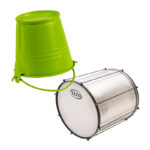
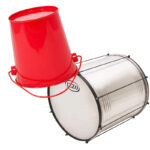
- Two large drums, one with a slightly lower note/pitch than the other. If you don’t have any large drums, two large upside-down buckets will work perfectly well.
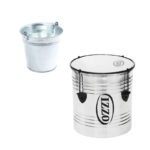
- A medium sized drum or Tom-Tom, or a smaller bucket or flower pot.
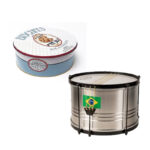
- A snare or marching drum, or a large round metal biscuit or sweet tin
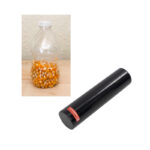
- Shakers, or plastic water bottle filled with dried peas
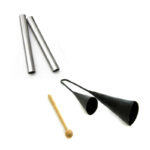
- Agogo bells, or two short lengths of metal pipe, or two empty tin cans
- A whistle, or the head piece of a recorder
- Plenty of wooden beaters
It’s fine to have more than one of each type of drum - the more the merrier.
Or if you have no drums or containers at all, try using the seat of two chairs for the two large drums, the back of a chair for the medium drum and the legs of the chair for the snare drum.
What you won't need:
- Prior music teaching experience
- Proper samba instruments
Setting the pulse
Begin by counting a steady, walking pace beat counting “One and Two and Three and Four and”:
1
+
2
+
3
+
4
+
etc
Keep counting round and round, or as you pace up and down. This pulse will be the foundation of the piece so get everyone synched with it.
In the examples below we'll mark the beats you play in red.
Practise the different Samba rhythms
The magical samba sound is made up from several different rhythms being played together, each on a different instrument. So next let’s practice each of the rhythms and instruments, one by one, as described below.
Start each time with everyone counting out the underlying walking pace rhythm (above) and then add the new rhythm on top. While you're learning the rhythms, get everyone to play each rhythm - never mind what their instrument is. Once all the players are playing the new rhythm confidently together, move on to the next one.
Later, once everyone has learned the different rhythms, we'll put them together, and at that stage, players should play just the rhythm associated with their instrument.
Here’s a short video showing how the different drum rhythms (large drum one, large drum two, medium drum and snare drum) fit together
Large Drum One (Surdo)
Play the lowest sounding drum(s) on Beats 1 and 3, represented in red and counting the black numbers as rests:
1
+
2
+
3
+
4
+
etc
Large Drum Two (Surdo)
Add in the higher pitched big drum(s) on Beats 2 and 4
1
+
2
+
3
+
4
+
etc
Played together the two large drums should make a steady two pitched main beat:
LO
HI
LO
HI
etc
These represent the large Surdo drums used to keep a steady beat in Samba music.
Medium Drum (Repinique)
Play this next rhythm on the medium sized drum(s). Remember to play the beats in red and rest on the black beats. Repeating the phrase “South A..me..ri..ca” will help you to remember the rhythm:
1
+
2
+
3
+
4
+
etc
South
...
...
A
me
ri
ca
...
...
Snare Drum (Caixa)
On the snare drum(s) or biscuit tin(s), add in this next rhythm. Repeating the phrase Zil….BraZil…BraZil will help you to play the rhythm but remember to start with Zil, NOT Bra:
1
+
2
+
3
+
4
+
etc
Zil
...
...
Bra
zil
...
...
Bra
Shakers
Now add in the Ganza or shakers, playing on each and every beat and offbeat.
1
+
2
+
3
+
4
+
Agogo bells
Lastly add in the Agogo Bells, playing the smaller higher pitched bell on the letter H and the larger low pitched bell on the letter L. Once again play the red notes and rest on the black notes:
1
+
2
+
3
+
4
+
H
H
L
+
H
H
L
Use the Rhythms to Create your Carnival performance
Once you’ve mastered each of the rhythms, start again at the top with everyone counting the basic walking pace rhythm and then build up the whole samba sound, one instrument at a time in the same order as above, until everyone is playing together.
Keep the whole band going for a few minutes and then give four even blasts on the whistle (keeping to the basic pulse), to signal a switch to the call and response pattern below.
Call and Response
The leader plays the call, keeping to the pulse, and everyone else answers with the response. Remember we are playing the rhythm of the words as if spoken. But you can also shout the words and play at the same time, or just shout the words, before resuming their rhythms.
📢
📢
📢
📢
1
+
2
+
3
+
4
+
CALL
We
want
you
.....
we
want
you
.....
1
+
2
+
3
+
4
+
RESPONSE
We
want
you
as a
new
re
cruit
1
+
2
+
3
+
4
+
Play only the numbers in red.
In the response play the words “as a” twice as fast as a double beat on the + after number two.
Repeat this round a few time. Then build up the full Samba sound again, adding in one instrument at a time and remembering to keep the beat steady.
Have the full band play round and round for a minute or two, then hush everyone, to get them to play as quietly as possible, but still keeping the beat steady.
Then gradually increase the volume, being careful not to speed up, and finish with the four whistles and the call and response played once by everyone in unison.
Brilliant!
THE INSTRUMENTS OF SAMBA
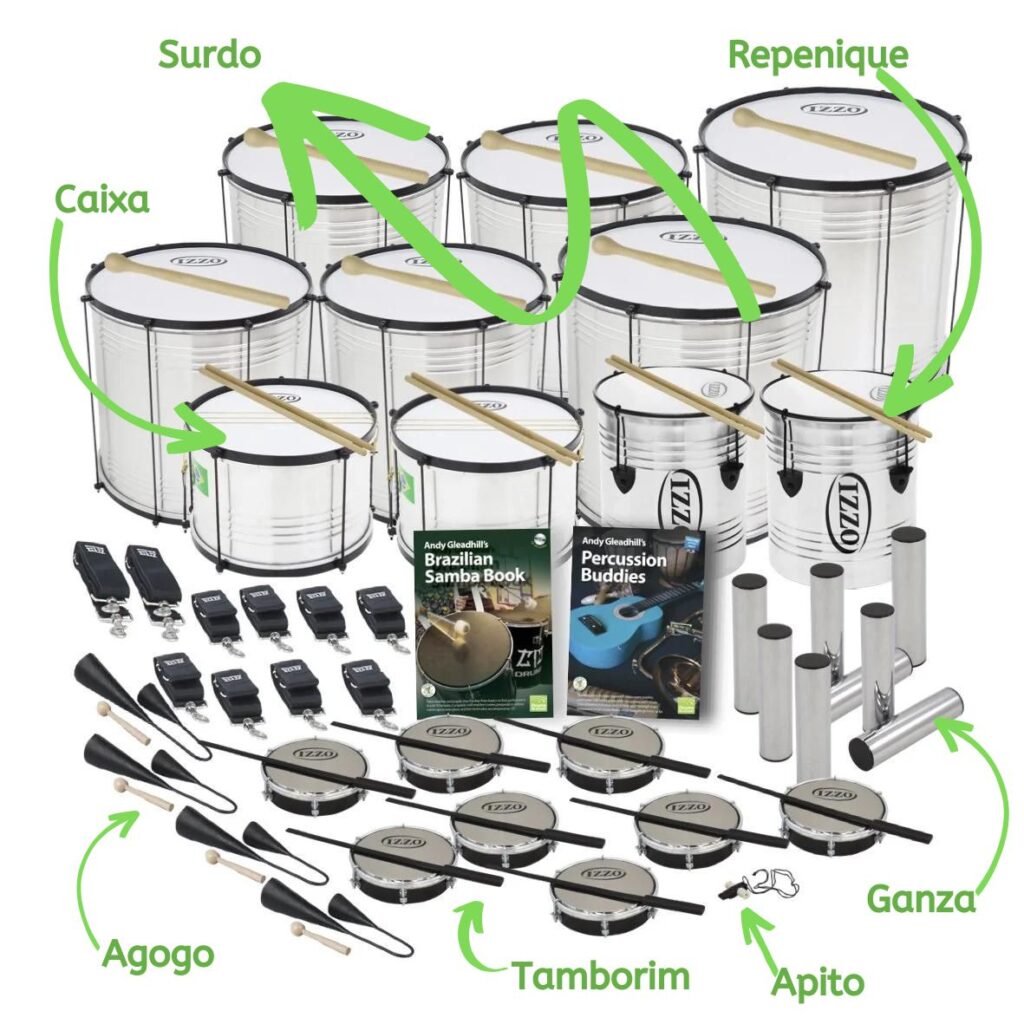
The instruments, like the music, are derived from African, European, and South American musical instruments.
SURDO
This is a large conical shaped drum with a deep shell. It is played in a variety of ways, most often with one soft padded beater and an open hand to dampen the sound. Occasionally it is played with two beaters in either hand, and sometimes it is played with a soft beater on the drum head and a hard drumstick striking the side or shell of the drum. The shell of the drum can be made from either wood or metal.
REPENIQUE
A medium sized, deep drum. Repeniques, sometimes called Repeke or Reps for short are played with one hard drumstick and an open hand.
CAXIA
The Caxia is a shallower drum with wire snares strung along the underside of one of the two drum heads, to give the drum its characteristic rattle. This drum makes a classic marching drum sound and is usually played with two sticks.
GANZA
A cylindrical tube filled with beads and shaken.
AGOGO BELLS
Two differently pitched metal funnel shaped bells, one high, one low, played with a wooden stick.
APITO
The Apito is a three-toned whistle with a pea in the chamber and tone holes at the side that control the pitch.
Two other Common Samba Instruments
TAMBORIM
A small, single headed drum held in one hand and played with a thin stick held in the other hand.
PANDEIRO
A large single headed hand held drum with metal jingles around the frame of the drum. It is sometimes struck and sometimes shaken, very similar to a Tambourine.
See our other articles on Samba and the Rio Carnival:
The Cultural History of Brazilian Samba Music
The role of Music in Rio Carnival
Ready to get started?
Browse our class music sets or book a chat with our founder.
